Tiny Planes Islands and Routes
Four distinct islands, private player fields, dispatch between them, and how to unlock longer routes safely.
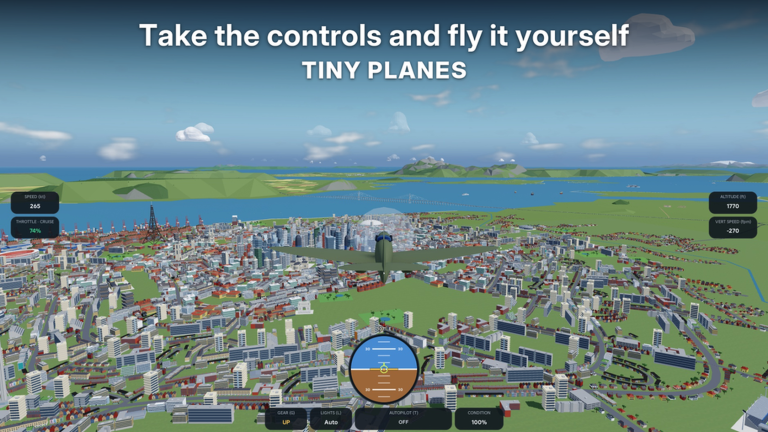
Tiny Planes spreads its career across four distinct islands, not a single endless runway. You build and manage a private island of your own, open dispatch routes between islands, and—when multiplayer is active—visit friends who each keep their own field (up to five players). This guide explains how islands and routes fit the money loop, when to unlock bigger aircraft for longer hops, how to use the map and autopilot for ferry flights, and how to visit other airports without wrecking someone else’s traffic. Start from Getting Started if your home strip is still unfinished.
Four islands, one career
The four islands are distinct destinations with different terrain footprints and route opportunities. You do not need to treat them as four identical starter pads. One island may favor a compact coastal hub; another may give you room for parallel runways or scenic approaches. Your progression fantasy is choosing a home build style, then connecting profitable legs outward—not paving every rock on day one.
Think in layers:
- Home island — tutorial runway, first gates, Josi’s first dispatch loops, daily claim routine.
- Near routes — short hops that keep cash flowing while you learn pavement tools from Airport Building.
- Cross-island routes — medium and longer legs that need better aircraft, fuel planning mindset, and trustworthy navigation.
- Social visits — flying to friends’ private islands for co-op play, barn-find tips, or joint disaster responses.
The Make Money guide covers how dispatch, codes, and upgrades fund those layers. This page focuses on geography and route discipline.
Private island progression (up to five players)
Each player owns private progression space. Multiplayer caps at five, and everyone still builds their own airfield. Visiting does not replace your home economy—your routes, shop purchases, and upgrades stay tied to your island. Use friends’ fields as inspiration and meetup points, then return to improve your own taxi flow and gate count.
Practical implications:
- Finish a usable home runway before sightseeing every neighbor.
- Copy layout ideas, not their entire unfinished mega-hub, if your cash cannot staff it.
- Keep your visitor parking plan ready for when others arrive (see etiquette below).
Details on co-op habits also live on the Players Hub.
Dispatch between islands
Income scales when planes leave home, complete a paid leg, and return or continue without human babysitting. Recruit pilots (tutorial Josi, then code Legendary Pilots) and keep the board busy. Opening a flashy long route with no pilot and a plane that cannot safely land at the far end wastes time.
Route checklist before you unlock a new island hop:
- Origin runway length and clear approaches support the airframe.
- Destination has a usable landing zone (yours, a public-feeling pad, or a friend’s agreed strip).
- A pilot is assigned, or you are ready to hand-fly / autopilot the ferry.
- Operating cost fits the payout—see fleet advice on the tier list and Best Starters for early hops.
Short reliable loops beat one heroic cross-map flight that fails half the time.
Unlock bigger planes for longer routes
Distance and payload demand grow together. Starter GA owns the first island loops; regionals open medium inter-island work; narrow-bodies and cargo heavies need Build Update infrastructure—runway length, gates, jet bridges—covered in Airport Building and the Build Update Guide.
Do not buy range you cannot host. A long-route airliner on a stubby tutorial strip becomes a hangar queen. Unlock order that usually works:
- Stabilize home dispatch with light aircraft.
- Extend pavement and add a working jet-bridge gate.
- Add one regional or cargo frame matched to new demand.
- Stretch into true airliners only when both ends of the route can handle them.
Cargo routes between islands are excellent diversifiers once a shed or cargo apron exists; passenger-only boards feel brittle when demand dips. Money priorities after codes are spelled out in How to Make Money.
Map key (M) and navigation habits
Press M for the map when you leave the comfort of your home pattern. Use it to:
- Orient toward other islands before you climb out blindly.
- Plan barn-find scouting loops without inventing fake GPS pins—see Barn Finds.
- Reacquire the field if weather, disasters, or night lighting confuse you.
Combine map checks with Controls: camera (V), UI hide (H), and the in-game help overlay (C). Knowing where you are matters as much as throttle management when islands stretch farther apart.
Autopilot (T) for ferry flights
T toggles autopilot—excellent for ferrying between islands while you watch the map or manage dispatch on another aircraft. Best practices:
- Engage after a stable climb, not during a chaotic takeoff roll through unfinished props.
- Disengage for learning landings, tight terrain near hidden finds, and disaster approaches that need human judgment.
- Do not treat autopilot as a substitute for runway design; bad thresholds still bite on arrival.
Ferry with autopilot, validate new geometry by hand. That split keeps both the tycoon and the sim halves healthy.
Visiting friends’ airports — etiquette
When you fly to another player’s private island:
- Confirm they have a usable runway and want visitors before you join the pattern.
- Enter a readable downwind/final; do not invent a base leg through their terminal façade.
- Park on a temporary spur or marked visitor pad—never block an active gate or the only taxi bypass.
- Agree on altitude bands if both of you are hand-flying while AI dispatch is live.
- Leave disaster staging areas clear if a tornado, fire, tsunami, or volcano event is running.
Good guests get invited back; guests who gridlock jet bridges get muted. Hosts should keep one obvious visitor strip and a holding taxi so friends are not inventing parking on the bridge nose.
Choosing an island for your build style
Pick a home identity early so every Build Update part reinforces it:
- Efficient hub — one strong runway, tight taxi loop, few gates, maximum dispatch uptime.
- Showcase field — longer scenic finals, custom towers and lights, VIP pad for barn-find trophies.
- Rescue base — clear emergency staging separated from passenger gates for Disaster Missions.
- Cargo-forward — shed access, wide taxilanes, routes tuned for freighter turnarounds.
You can remix later; demolishing three times costs more attention than choosing a lane after the tutorial. Freeform curves and any-angle runways from the Build Update make shoreline-hugging layouts possible—use them to solve terrain, not to scribble.
How islands tie to the rest of the wiki
- Airport Building — pavement that supports the routes you open.
- Controls — stick skills for arrivals on unfamiliar islands.
- Players — five-player private islands and co-op norms.
- Make Money — codes, daily boosts, dispatch, and upgrade spending.
- Barn Finds — exploration across islands after cash is safe.
- Disaster Missions — event payouts that often span multiple islands.
Suggested first week on the map
Day one: home island only—runway, Josi, codes, one profitable loop. Day two–three: one neighboring island route with a plane you can land tired. Mid week: cargo diversification and a visitor pad. Later: barn-find scouting and disaster readiness with map fluency. Stretch distance only as fast as your fleet and friends’ fields can absorb.
Master the four islands as a network, not a checklist of screenshots. Routes that complete reliably fund everything else Tiny Planes offers.
Frequently Asked Questions
Quick answers for Tiny Planes pilots and airport builders.
How many islands are in Tiny Planes?
Four distinct islands. You progress on a private island and open dispatch routes between them as your fleet and runways allow.
Do multiplayer players share one island?
No. Up to five players each manage a private island and can fly to visit each other after home fields are usable.
When should I unlock longer inter-island routes?
After short home loops are profitable and your aircraft plus runway length can handle the far-end landing. Bigger planes for longer routes come after infrastructure—not before.
What are map (M) and autopilot (T) used for?
M opens the map for orientation between islands and exploration. T engages autopilot for ferry hops; turn it off for practice landings and tight disaster or barn-find flying.
How should I behave when visiting a friend's airport?
Use a clear pattern, park off active gates, and avoid blocking taxi bypasses or disaster staging. Ask before treating their terminal as your playground.